

Cinema contains a kind of silent, almost invisible magic that is woven frame by frame in the darkness of an editing room until it explodes onto our screens. It is the illusion that makes us believe in dinosaurs coming back to life, parallel universes at war, or impossible missions that defy the laws of physics. Behind this curtain of wonders, often anonymous, we find the talent of Alba Sánchez-Serrano, from Mijas. Her name is the thread that connects the sun of Calahonda to the stars of the galaxies created by George Lucas' legendary dream factory, Industrial Light & Magic. At 29, this architect of the impossible has already made her mark on the collective imagination with her work on sagas such as 'Star Wars', 'Mission Impossible' and 'Jurassic World', a stellar journey recognised with an Emmy Award for her work, and that of her colleagues, on the series 'Chernobyl'. At Mijas Comunicación, we crossed the digital ether to chat with her and delve into the anatomy of her art.
Your career is an example of Mijas talent succeeding on a global level. What prompted you to make the leap from Mijas to an industry as competitive as visual effects? Was there a film or key moment that influenced you?
I've always loved drawing since I was little, and I became interested in digital art when I was given a drawing tablet for my computer when I was 13 or 14. What I did know was that I wanted to do something creative and modern. But it's been a very gradual process, not something that happened overnight. The first step was to move to Madrid to study Digital Animation at U-tad University, which was one of the few places offering degrees in digital art a decade ago. At first, I was drawn to Pixar and Disney films, but it was when I gained a better understanding of how the industry worked that I decided to make the leap to visual effects films.
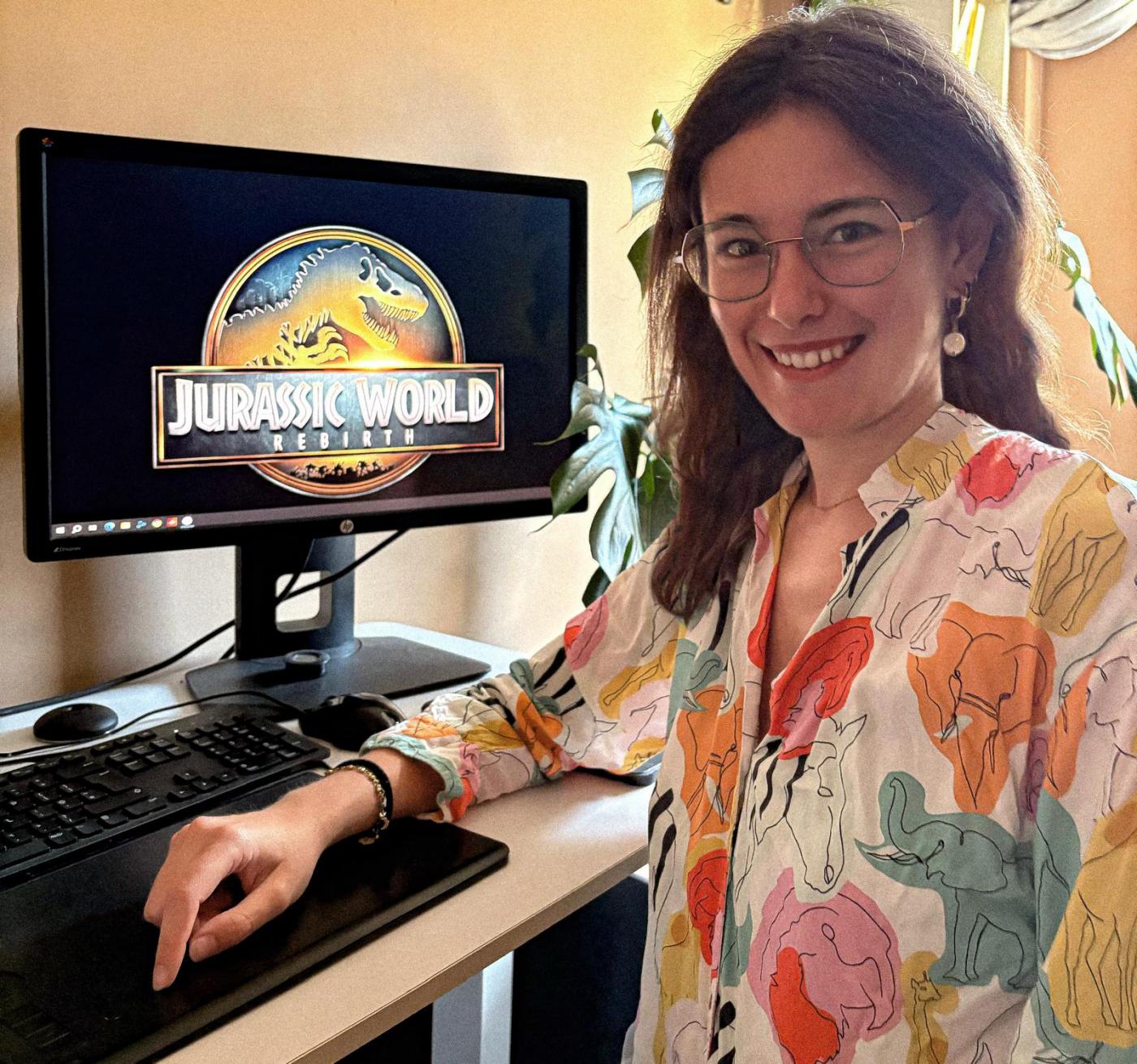
- Alba Sánchez-Serrano trabajando en la última película de la saga de Parque Jurásico
- | Cedida.
After studying in Madrid, you moved to London. How difficult is it for a young Spanish talent to break into one of the meccas of special effects?
The good thing about London is that if you work, you can get ahead. There are lots of companies and opportunities. Obviously, it was difficult at first. I started in a bridge position where I was paid minimum wage, and in my spare time, they offered us training to get the job we wanted. I had no real experience in visual effects, only practical experience in animation, but that position helped me fill in the gaps. It was hard at first, working long hours and being alone, far from my family and my partner, but seeing that the effort pays off is a great motivation to keep pushing through the tough times.
Many people don't know exactly what the job of a 'VFX composer' (visual effects) involves. Tell us about your day-to-day work.
That's normal, at first I didn't even know this was a job! The process I go through to do my work is like an assembly line. To create a dinosaur, for example, one person designs it, another models it in 3D, another gives it colour and texture, another lights it and another animates it. That's what I receive, and my job is to combine it with the footage shot on the actual set to integrate everything and make it work together. I make sure that the dinosaur moves the sand when it steps on it and leaves footprints, that it casts the correct shadows, and that if it makes its way through the jungle, it moves the plants, and I make all the necessary colour and lighting adjustments so that it looks like everything was filmed at the same time. Basically, I integrate the digital image into the real image.
You've worked in worlds as different as the realism of Chernobyl and the fantasy of Star Wars. Is it harder to create an effect that looks real or one that is purely fantastical?
Both have their difficulties. The fantastical is more open, but also more subjective, and it can be tricky to align the vision of supervisors, clients and directors.
Realism, on the other hand, has to look real, and emulating reality 100% is very difficult because, well, we all know reality and there are always small details, especially in organic elements, that are complex to achieve. Every project and every shot is a world in itself, depending on how it was shot and the creative licence you can take when tackling the project.
You work at Industrial Light & Magic, the company founded by George Lucas. Can you feel that history in the air?
I'm really excited to work here because, at the end of the day, it's a Disney company, which was my dream as a child. What I like most is the collaboration that is generated and encouraged. I'm surrounded by very talented artists from whom you can constantly learn. I think the difference between here and other studios is that everyone can express their opinion and contribute ideas, regardless of their department or position in the hierarchy. Everyone is listened to. We work with a hybrid model: we go to the office twice a week, which is decorated with lots of film memorabilia, such as hand-painted methacrylate pieces from the era of practical effects, and of course, Star Wars figures.
You were part of the team that won an Emmy for 'Chernobyl'. What did that recognition mean to you?
I was thrilled. It was one of my first projects and we all thought it looked really good, but when it came out and got that reception, it was a joy. Our supervisor brought the Emmy to the studio so we could all see it and take pictures with it. However, I think we've done better work that perhaps hasn't received as much recognition. Awards are nice, but there are projects I'm just as proud of.
Such as?
I'm very happy with the work we did on the series 'Andor'. It's probably my favourite project. I was really excited to be involved in something from 'Star Wars' and, on top of that, everyone was very committed. The atmosphere was great, pleasant, and the visual effects are really good because everything was filmed with integration in mind. Although they are fantasy sets, everything was very well thought out, using references from real locations to make it look as realistic as possible. Whether I win awards or not, I think it's a very beautiful piece of work.
You've been involved in blockbusters such as 'Jurassic World' and 'Mission Impossible'. How do you manage nerves and deadlines in such a demanding environment?
We always maintain the same high standards on every project. The difference with big productions is that they usually have a bigger budget and therefore more time and resources. The company's technical standards are already very high, so we can't do anything below a certain level. The only real tension comes when the deadline is approaching and we're behind schedule. That's when you might have to work overtime and you feel the pressure because the shot you're working on is your responsibility. But in general, we try very hard to make sure that no one gets too overwhelmed. The industry is moving forward and now they're concerned about people not 'burning out'.
After working on some of the biggest film franchises, what new professional challenges are you setting yourself?
My next goal is to continue climbing within the company, start taking on more responsibility and, in the future, I would like to be head supervisor on a film or series. In terms of projects, rather than working on sequels, which I like, I would love to be involved in the next big new saga that comes along.
Your professional life has taken you far away, do you still have ties to Mijas?
Yes, of course. I go back several times a year because my parents still live in Calahonda. I love going home and going to the beach. I try to go mainly in May, June or September, and of course at Christmas. I still live there whenever I can.

- Esta artista digital de 29 años se crió en Calahonda
- | Cedida.
Finally, what advice would you give to a young person from Mijas who might want to follow in your footsteps?
I would tell them that it's a viable option, because they only have to look at me: I didn't know anything about this either, and I've made it this far.
I'm no better than anyone else. But I would recommend that they work hard. It's a very competitive world, but if you put in enough effort and get a good education, whether that's a degree, vocational training or doing lots of projects, you can make it happen. You have to work hard and pursue your dreams.
And so, with the same apparent simplicity with which one pursues a childhood dream, the conversation comes to an end. We say goodbye with best wishes and the video call ends so that the architect of distant galaxies can return to her work. But the testimony of a girl from Calahonda who discovered that to build new worlds with the virtual light of a London studio, all you need to do is remember the real brightness of the world you come from, remains floating in the air.


